Staying focused can feel like an uphill battle when you have ADHD. You sit down with every intention of finishing an important task, but within minutes your attention shifts to something else. A notification pops up, a random thought appears, or you suddenly remember another task that feels just as urgent. Before you know it, hours have passed, and the work you planned to complete is still waiting.
If this sounds familiar, you’re not alone. Millions of adults and students with ADHD experience the same struggle every day. It’s not because they’re lazy, careless, or lacking willpower. ADHD affects the brain’s ability to manage attention, organize tasks, and regulate motivation, making it much harder to stay engaged with work that isn’t immediately rewarding.
Why Focusing Feels Different with ADHD
Many people believe that ADHD means someone simply “can’t pay attention.” In reality, that’s only part of the story. People with ADHD can often focus intensely on activities they find exciting or stimulating—a phenomenon known as hyperfocus. The real challenge is controlling where that attention goes and keeping it on tasks that require sustained mental effort, especially when they’re repetitive, complex, or uninteresting.

This happens because ADHD affects the brain’s executive functions. These are the mental skills responsible for planning, prioritizing, starting tasks, managing time, and resisting distractions. When these systems don’t work efficiently, even simple responsibilities can feel overwhelming.
The Biggest Myth About ADHD and Motivation
One of the most common misconceptions is that people with ADHD just need to “try harder” or become more disciplined. The truth is, ADHD isn’t a motivation problem—it’s a regulation problem.
Many people with ADHD genuinely want to complete their work, study consistently, or stay organized. The difficulty lies in getting started, maintaining momentum, and returning to a task after an interruption. Success isn’t usually about increasing effort; it’s about creating an environment and routine that work with the way the ADHD brain processes information.
Why Medication Isn’t the Only Solution
Medication can be an effective treatment for many people, but it’s not the only path to better focus. Some individuals choose not to take medication, while others may not have access to it or may experience side effects that make it unsuitable.
The good news is that research and real-world experience show that practical strategies—such as structured routines, breaking tasks into smaller steps, reducing distractions, improving sleep, exercising regularly, and using productivity systems designed for ADHD—can significantly improve focus and daily functioning. These approaches don’t replace professional medical advice, but they can make a meaningful difference whether or not medication is part of your treatment plan.
What You’ll Learn in This Guide
In this guide, you’ll discover practical, science-informed strategies that help many people with ADHD stay focused without relying solely on medication. You’ll learn how to work with your brain instead of against it, create routines that are easier to maintain, reduce distractions, improve productivity, and build habits that support long-term success.
Whether you’re a student, professional, freelancer, entrepreneur, or simply looking for ways to manage daily responsibilities more effectively, these techniques can help you take better control of your attention and accomplish more with less frustration.
Understanding ADHD and Focus
To improve focus with ADHD, it helps to understand why staying on task feels more difficult in the first place. ADHD isn’t simply about getting distracted easily. It’s a neurodevelopmental condition that affects how the brain manages attention, motivation, memory, and self-control.
Many people with ADHD know exactly what they need to do. The challenge isn’t a lack of knowledge or ambition—it’s turning intention into action and maintaining focus long enough to complete the task. Understanding how the ADHD brain works can help you choose strategies that match the way your brain naturally functions instead of fighting against it.
What Happens Inside the ADHD Brain?
ADHD affects several brain functions that play a critical role in planning, organizing, prioritizing, and sustaining attention. While every person’s experience is different, there are a few common challenges that explain why focusing can feel so difficult.
Executive Dysfunction
Executive functions are the brain’s management system. They help you plan your day, organize information, switch between tasks, control impulses, and stay focused until a job is finished.
For someone with ADHD, these skills don’t always work as efficiently. This is known as executive dysfunction.
As a result, everyday situations may feel much harder than they appear to others. You might:
- Struggle to start important tasks, even when you know they’re urgent.
- Jump between unfinished projects without completing them.
- Lose track of priorities.
- Feel overwhelmed by tasks that seem simple to other people.
- Have difficulty organizing your workspace or schedule.
These challenges aren’t caused by laziness or poor discipline. They’re part of how ADHD affects the brain’s ability to manage information and regulate behavior.
Dopamine is a neurotransmitter involved in motivation, learning, reward, and attention. It helps the brain recognize what is worth focusing on and encourages you to keep working toward a goal.
Research suggests that people with ADHD often have differences in how dopamine functions. Because of this, tasks that don’t provide immediate interest or rewards can feel mentally exhausting, while exciting or highly stimulating activities become much easier to focus on.
This explains why someone with ADHD may:
- Spend hours playing a game or working on a favorite hobby.
- Lose focus after just a few minutes of routine paperwork.
- Delay important work until the pressure of a deadline creates enough urgency to act.
It’s not a matter of caring less—it’s a difference in how the brain responds to motivation and rewards.
Time Blindness
Many people with ADHD experience time blindness, which makes it difficult to accurately judge how much time has passed or how long a task will take.
This can lead to challenges such as:
- Underestimating project timelines.
- Running late despite good intentions.
- Spending too much time on one activity.
- Forgetting important deadlines.
- Feeling like the day disappeared without accomplishing planned tasks.
Because the brain isn’t naturally tracking time effectively, external tools like timers, calendars, reminders, and visual schedules become essential—not optional.
Working Memory Challenges
Working memory is your brain’s temporary storage system. It allows you to hold and use information while completing a task.
When working memory is weaker, it becomes easier to:
- Forget instructions halfway through.
- Lose your train of thought.
- Walk into a room and forget why you went there.
- Misplace everyday items.
- Skip important steps while completing a project.
This is why many people with ADHD rely on written notes, checklists, planners, and digital reminders instead of trying to remember everything mentally. Building external systems often works better than relying on memory alone.
Why Motivation Comes Before Action
Many people believe that action creates motivation. For individuals with ADHD, the process often works differently.
The ADHD brain usually needs enough interest, novelty, urgency, or emotional significance before it can fully engage with a task. Without that spark, even simple responsibilities can feel impossible to start.
This is why people with ADHD often notice they work best when:
- A deadline is approaching.
- The task feels exciting or meaningful.
- There’s an immediate reward.
- Someone else is working alongside them.
- The work is broken into small, manageable steps.
Rather than waiting for motivation to appear naturally, successful ADHD strategies focus on creating it through structure, routines, and small wins.
Can You Improve ADHD Focus Without Medication?
The short answer is yes—for many people, significant improvements are possible. While medication can be highly effective and is an important treatment option for many individuals, it’s not the only way to improve focus and daily functioning.
Whether you choose not to take medication, don’t have access to it, or simply want additional ways to manage ADHD, practical lifestyle strategies can make a meaningful difference.
What Research Says
Research shows that ADHD management works best when multiple strategies are combined. Alongside medical treatment when appropriate, behavioral techniques, healthy routines, regular exercise, quality sleep, stress management, and structured productivity systems have all been shown to support better attention and executive functioning.
No single habit will eliminate ADHD symptoms overnight. However, consistently applying several evidence-based strategies can reduce distractions, improve task completion, and make daily responsibilities feel more manageable over time.
The goal isn’t to “fix” the ADHD brain—it’s to build systems that help it perform at its best.
Lifestyle Changes That Make the Biggest Difference
Small, consistent habits often have a greater long-term impact than searching for one perfect productivity trick.
Many adults with ADHD find noticeable improvements by focusing on habits such as:
- Following a consistent daily routine.
- Breaking large tasks into smaller, manageable steps.
- Exercising regularly to support attention and mood.
- Prioritizing seven to nine hours of quality sleep.
- Eating balanced meals with enough protein and staying hydrated.
- Reducing digital distractions during work sessions.
- Using planners, calendars, timers, and reminders to stay organized.
- Taking short movement breaks to refresh attention throughout the day.
These habits work together to reduce mental overload and make it easier to stay engaged with important tasks.
Setting Realistic Expectations
Improving focus with ADHD is a gradual process, not an overnight transformation. Some days will feel productive, while others may still be challenging—and that’s completely normal.
Instead of aiming for perfect concentration all day, focus on building systems that help you return to your work whenever your attention drifts. Every completed task, no matter how small, is progress.
The most effective approach isn’t about becoming someone without ADHD. It’s about understanding how your brain works, recognizing your strengths, and creating routines that support your success in a way that’s both practical and sustainable.
In the following sections, you’ll learn proven strategies that you can start using immediately to improve focus, reduce overwhelm, and get more done without relying solely on medication.
1. Work With Your Brain’s Natural Energy Cycles
One of the biggest mistakes people with ADHD make is trying to follow productivity advice designed for everyone else. Many traditional work methods encourage sitting at a desk for hours without interruption, pushing through mental fatigue, and expecting consistent focus from morning until evening.

For most people with ADHD, that approach simply doesn’t match how their brain functions.
Attention isn’t constant throughout the day. It naturally rises and falls in cycles, and those fluctuations tend to be even more noticeable with ADHD. Instead of fighting these changes, it’s far more effective to build your work routine around them.
When you schedule demanding tasks during your highest-energy periods and allow yourself regular mental breaks, you’ll often accomplish more in less time while feeling less overwhelmed.
Why Forcing Long Work Sessions Doesn’t Work
Many people believe that productive work requires sitting for several uninterrupted hours. While this might work for some, it’s rarely the best strategy for an ADHD brain.
As attention begins to fade, the brain has to work harder to stay engaged. Eventually, mental fatigue sets in. At that point, you may find yourself reading the same paragraph repeatedly, staring at the screen without making progress, or switching to social media, email, or other distractions without realizing it.
The problem isn’t a lack of effort—it’s cognitive overload.
Long work sessions can also increase frustration. When you struggle to maintain focus, it’s easy to assume you’re not working hard enough, even though your brain simply needs a chance to reset.
Rather than forcing yourself to stay productive for hours at a time, it’s more effective to work in shorter, highly focused intervals. These structured sessions give your brain clear starting and stopping points, making it easier to begin tasks and maintain concentration.
Remember, productivity isn’t measured by how long you sit at your desk. It’s measured by the quality of the work you complete.
Find Your Peak Focus Hours
Every person has certain times of the day when their brain naturally performs better. For people with ADHD, identifying these periods can significantly improve productivity.
Some people feel most alert within the first few hours after waking up, while others don’t reach their peak concentration until the afternoon or evening.
Instead of scheduling your most important work based solely on your calendar, schedule it around your energy.
For one week, pay attention to when you feel:
- Most alert and mentally clear.
- Able to concentrate without forcing yourself.
- Naturally motivated to begin tasks.
- Less likely to become distracted.
You may notice patterns such as:
- Morning (7 AM–11 AM): Best for creative work, writing, studying, or problem-solving.
- Afternoon (1 PM–4 PM): Better for meetings, emails, administrative tasks, or routine work.
- Evening (7 PM–10 PM): Ideal for people who naturally become more focused later in the day.
Once you discover your peak focus window, protect it. Avoid filling those hours with meetings, social media, or low-priority tasks. Reserve them for work that requires your highest level of concentration.
Use Focus Sprints Instead of Marathon Sessions
One of the most effective productivity strategies for ADHD is the Focus Sprint.
Instead of trying to stay focused for several hours, commit to giving one task your full attention for a short, manageable period. Knowing there’s a break coming makes it easier to get started and reduces the mental pressure of a long work session.
During a focus sprint:
- Work on one task only.
- Turn off notifications.
- Keep your phone out of reach.
- Close unnecessary browser tabs.
- Set a timer before you begin.
- Avoid checking messages or email until the sprint is over.
When the timer ends, step away from your workspace for a few minutes. Stretch, drink water, take a short walk, or simply rest your eyes. Giving your brain a brief reset helps restore attention before the next sprint.
These short bursts of concentrated work are often more productive than spending several unfocused hours at your desk.
Recommended Work-to-Rest Ratios
There isn’t a single focus schedule that works for everyone with ADHD. The goal is to experiment until you find a rhythm that matches your attention span and energy levels.
Here are a few effective work-to-break ratios:
| Focus Time | Break Time | Best For |
|---|---|---|
| 15 minutes | 5 minutes | Beginners, severe distractibility, task initiation |
| 20 minutes | 5 minutes | Writing, studying, office work |
| 25 minutes | 5 minutes | General productivity (Pomodoro Technique) |
| 45 minutes | 10 minutes | Deep work after building focus stamina |
| 60 minutes | 10–15 minutes | Experienced professionals working on complex projects |
If you’re just starting, don’t force yourself into 60-minute sessions. Begin with 15 or 20 minutes of focused work. As your ability to concentrate improves, gradually extend your work intervals.
The goal isn’t to work longer—it’s to work consistently without reaching the point of mental exhaustion.
Pro Tip: Stop your work session while you still have a little energy left. Taking a break before you’re completely drained makes it much easier to return to your task with a clear mind and renewed focus.
2. Break Big Tasks Into Tiny Wins
One of the biggest reasons people with ADHD procrastinate isn’t because they don’t want to do the work—it’s because the task feels too big to know where to begin.
When your brain sees a large project, it often treats it as one massive, overwhelming responsibility. Instead of identifying the first step, your mind focuses on everything that needs to happen, making the task feel exhausting before you’ve even started.
The solution isn’t to work harder. It’s to make the first step so small that getting started feels easy.
Breaking a project into tiny, manageable actions reduces mental resistance, builds momentum, and creates a series of quick wins that keep you moving forward.
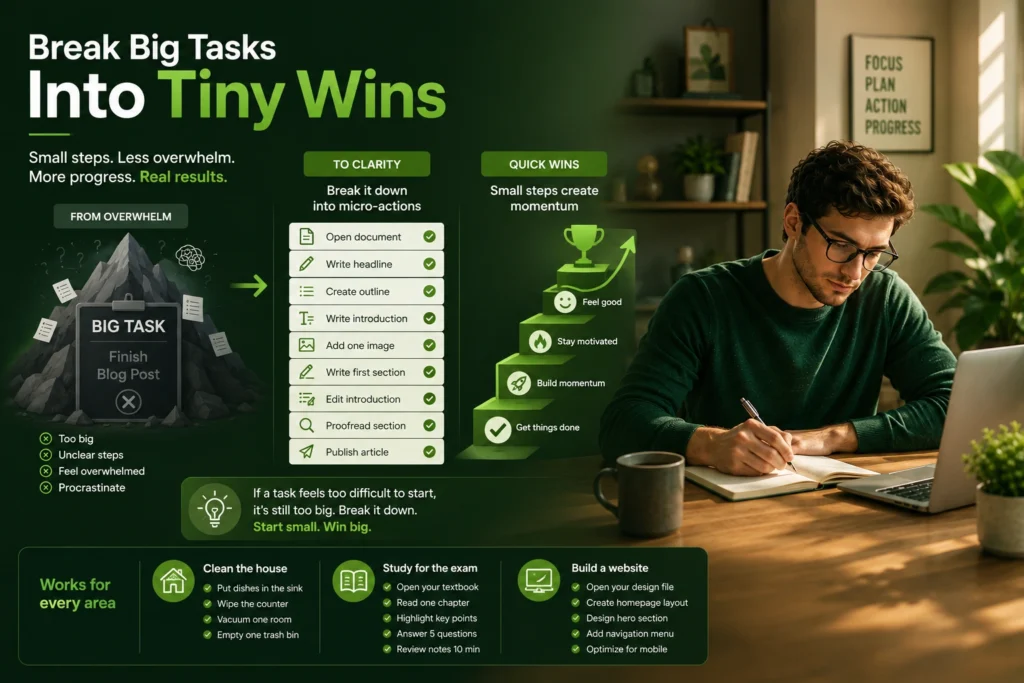
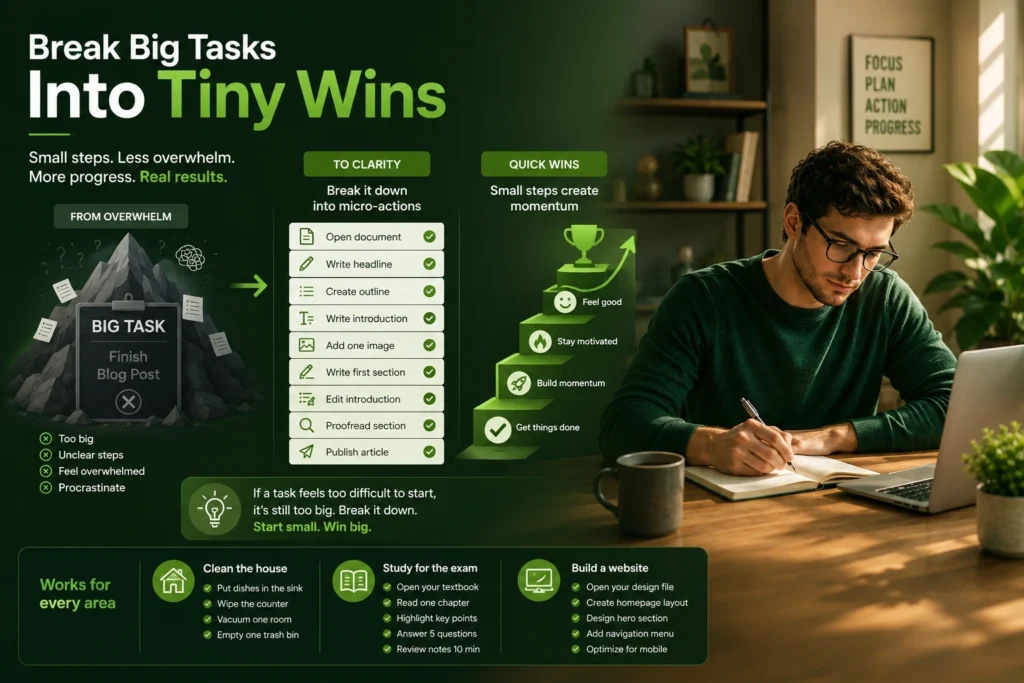
Why Large Tasks Feel Overwhelming
Have you ever written something like “Finish blog post” on your to-do list and then ignored it all day?
The problem isn’t the task itself—it’s that your brain doesn’t know what “finish” actually means.
A single item like “Write blog post” includes dozens of smaller decisions:
- Choose a topic.
- Research keywords.
- Create an outline.
- Write the introduction.
- Add headings.
- Find images.
- Edit the content.
- Proofread.
- Publish the article.
Looking at all of these steps at once can trigger overwhelm and make it difficult to begin. This is a common challenge for people with ADHD because executive dysfunction makes planning and task initiation more demanding.
The larger and more vague a task appears, the more likely your brain is to delay it.
Instead of asking yourself to complete the entire project, focus only on the very next action.
Turn Projects Into Micro-Actions
Micro-actions are the smallest possible steps you can take toward completing a task. They require very little mental effort, making them much easier to start.
The goal is simple: Never write a task that’s bigger than one action.
For example, instead of writing:
❌ Write blog post
Break it into:
✅ Open your writing document.
✅ Write a working headline.
✅ Create the main headings.
✅ Write the introduction.
✅ Add one supporting image.
✅ Write the first section.
✅ Edit the introduction.
✅ Proofread one section.
✅ Publish the article.
Each completed step gives your brain a small sense of progress, making it easier to continue with the next one. Over time, these small wins build momentum and reduce the anxiety that often comes with large projects.
This approach works for almost every type of work.
Instead of:
❌ Clean the house
Try:
- Put dirty dishes in the sink.
- Wipe the kitchen counter.
- Vacuum one room.
- Empty one trash bin.
Instead of:
❌ Study for the exam
Try:
- Open your textbook.
- Read one chapter.
- Highlight important points.
- Answer five practice questions.
- Review your notes for ten minutes.
Instead of:
❌ Build a website
Try:
- Open your design file.
- Create the homepage layout.
- Design the hero section.
- Add the navigation menu.
- Optimize one page for mobile.
A Simple Rule to Remember
If a task feels too difficult to start, it’s probably still too big.
Keep breaking it down until the first step feels almost effortless. Sometimes the smallest action—like opening your laptop or creating a new document—is all it takes to overcome procrastination and build momentum.
For people with ADHD, progress rarely comes from waiting for motivation. It comes from making the next step so simple that your brain has no reason to avoid it. Once you’ve started, continuing becomes much easier than starting.
3. Use External Systems Instead of Memory
One of the most common frustrations for people with ADHD is feeling like they constantly forget things. You might remember an important idea while making coffee, only to lose it moments later. You may walk into another room and forget why you went there, miss a deadline despite good intentions, or start one task and become distracted before finishing it.
If this happens often, it doesn’t mean you’re careless or irresponsible. It means you’re relying on a system—your memory—that isn’t designed to carry everything on its own.
The most productive people with ADHD don’t try to remember more. They build external systems that remember for them.
Instead of expecting your brain to store every appointment, deadline, and idea, move that information into tools you can trust. This reduces mental overload and frees your attention for the work that actually matters.
Why ADHD Brains Struggle with Remembering
Many people assume ADHD only affects attention, but it also impacts working memory—the brain’s ability to temporarily hold and use information while completing a task.
Working memory acts like a mental notepad. It helps you remember what you’re doing, what comes next, and what information you need at that moment. When this system becomes overloaded, important details can disappear quickly.
This is why you might:
- Forget what someone just told you.
- Lose track of your next step in a project.
- Miss appointments or deadlines.
- Misplace everyday items like your keys or phone.
- Remember important tasks only after it’s too late.
Trying harder usually doesn’t solve the problem. Instead, the goal is to stop relying on memory whenever possible.
Think of your brain as a place for thinking, not storage. The less information you force yourself to remember, the more mental energy you’ll have for solving problems, making decisions, and staying focused.
Use Sticky Notes for Immediate Reminders
Sticky notes are one of the simplest tools for reducing mental load. They’re most effective for tasks you need to see throughout the day.
Place them where they’re impossible to ignore, such as:
- On your computer monitor.
- Near your workspace.
- On the bathroom mirror.
- Next to the front door.
Keep each note short and actionable.
Instead of writing:
❌ Finish everything today.
Write:
- Send client proposal.
- Drink water.
- Call the dentist.
- Review today’s schedule.
A quick visual reminder is often enough to keep important tasks from slipping through the cracks.
Keep a Whiteboard in Your Workspace
A whiteboard gives you a clear overview of your priorities without opening another app or searching through multiple notebooks.
Use it to display:
- Your top three priorities for the day.
- Weekly goals.
- Project deadlines.
- Upcoming appointments.
- Ideas that pop into your mind while working.
Seeing your tasks in one place reduces decision fatigue and makes it easier to stay focused on what matters most.
Set Digital Reminders Before You Need Them
Your phone can either distract you or help you stay organized. The difference lies in how you use it.
Instead of relying on memory, create reminders as soon as something becomes important.
Useful reminders include:
- Client meetings.
- Bill payment dates.
- Medication schedules.
- Grocery shopping.
- Assignment deadlines.
- Follow-up emails.
Don’t trust yourself to remember something later. If it matters, record it immediately.
A reminder set today can prevent unnecessary stress tomorrow.
Block Time on Your Calendar
A calendar shouldn’t only tell you when meetings happen—it should also tell you when you’ll do your important work.
This is known as calendar blocking.
Rather than writing:
❌ Write report today.
Schedule it like this:
- 9:00–9:45 AM: Research.
- 10:00–10:45 AM: Write first draft.
- 2:00–2:30 PM: Edit and proofread.
Giving every task a specific place in your day reduces the chances of forgetting it or putting it off until the last minute.
Treat these time blocks like appointments with yourself.
Create Simple Checklists
Checklists remove the pressure of remembering every step of a process.
Instead of asking yourself, “What should I do next?”, you simply follow the next item on the list.
For example, if you’re publishing a blog post, your checklist might look like this:
- Research the keyword.
- Write the outline.
- Draft the introduction.
- Complete the main sections.
- Add images.
- Proofread the article.
- Optimize SEO elements.
- Publish the post.
- Share it on social media.
By checking off one item at a time, you reduce mental clutter and make steady progress without constantly stopping to think about what comes next.
Build a System You Can Trust
The goal isn’t to have a perfect memory—it’s to create reliable systems that support you every day.
When reminders, notes, calendars, and checklists become part of your routine, you spend less time worrying about forgetting things and more time focusing on meaningful work.
For people with ADHD, success often comes from designing an environment that supports attention, not from trying to remember everything on your own.
4. Remove Friction Before You Start
For many people with ADHD, getting started is often the hardest part of any task. It’s not because the work is too difficult—it’s because there are too many small decisions standing between you and the first step.
You sit down to work, then realize your laptop needs charging. You open your browser but can’t find the document you need. You remember you forgot to fill your water bottle. A notification appears on your phone, and before you know it, twenty minutes have disappeared.
These tiny interruptions may seem harmless, but together they create enough resistance to make starting feel overwhelming.
The easier you make it to begin, the more likely you are to stay focused.
Think of it this way: every extra decision drains a little mental energy. By removing those obstacles before you start working, you give yourself a smoother path into deep focus.
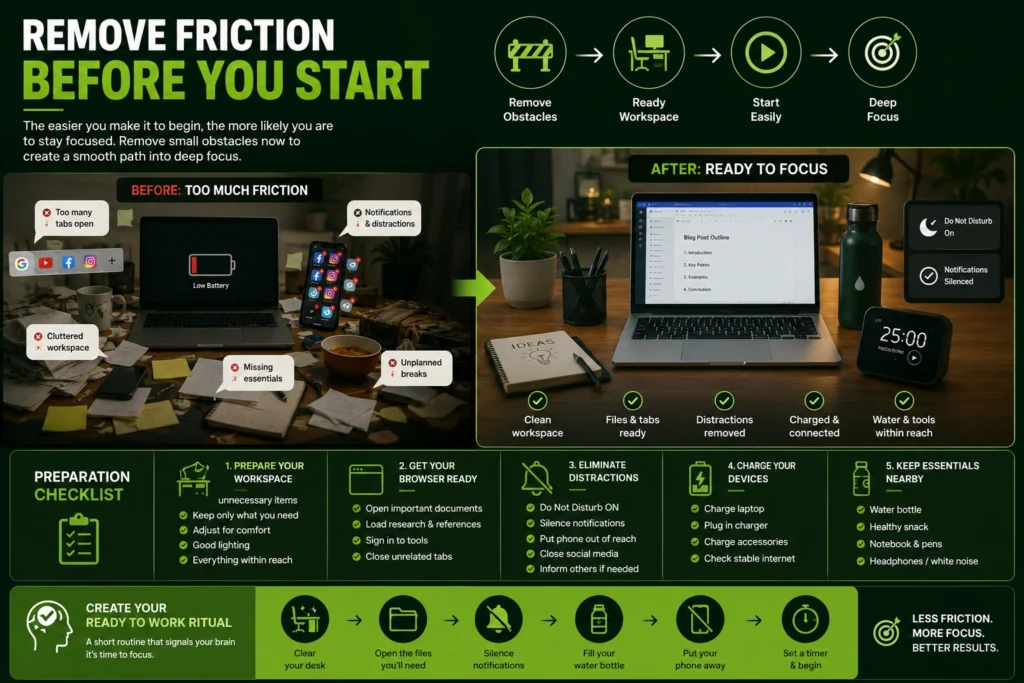
Prepare Your Workspace Before You Begin
A cluttered workspace often leads to a cluttered mind.
Before starting an important task, spend a few minutes setting up your environment. You don’t need a perfectly organized office—just a space that supports concentration.
Try to:
- Clear unnecessary items from your desk.
- Keep only the tools you’ll use for the current task.
- Adjust your chair and monitor for comfort.
- Make sure your lighting is comfortable.
- Keep notebooks, pens, or reference materials within easy reach.
When everything you need is already in place, you’re less likely to interrupt your workflow searching for supplies.
Keep Your Browser Tabs Ready
One of the easiest ways to lose momentum is constantly switching between websites or searching for files after you’ve already decided to work.
Before your focus session begins:
- Open the document you’ll be working on.
- Load any research articles or reference materials.
- Sign in to the tools you’ll need.
- Close tabs unrelated to your current task.
For example, if you’re writing a blog post, have your writing document, keyword research tool, and reference sources open before you start. This reduces unnecessary clicks and helps you stay in the flow.
Close Distractions Before They Interrupt You
Distractions are much easier to prevent than to recover from.
Even a quick glance at a message or social media notification can break your concentration, and it may take several minutes to fully regain your focus.
Before starting a work session:
- Turn on Do Not Disturb mode.
- Silence unnecessary notifications.
- Put your phone out of reach.
- Close social media apps.
- Exit unrelated browser tabs.
- Let family members or coworkers know you need uninterrupted time if possible.
The fewer interruptions you face, the easier it becomes to stay engaged with your work.
Charge Your Laptop and Devices
It sounds simple, but running out of battery in the middle of a productive session can completely disrupt your momentum.
Before you begin:
- Charge your laptop.
- Plug in your charger if you’ll be working for an extended period.
- Charge wireless headphones, keyboard, or mouse if you use them.
- Make sure your internet connection is stable.
These small preparations eliminate avoidable interruptions and help you stay focused until your session is complete.
Keep Water and Essentials Nearby
Small breaks often turn into long distractions.
You get up to grab a glass of water, notice the dishes in the sink, check your phone, start another task, and suddenly you’ve forgotten what you were originally working on.
Reduce those opportunities by keeping your essentials close to your workspace.
Consider having:
- A bottle of water.
- A healthy snack.
- A notebook for quick ideas.
- Pens or highlighters.
- Headphones if you use background music or white noise.
Having everything within reach makes it easier to remain in your work environment instead of wandering away from it.
Create a “Ready to Work” Ritual
The most productive people with ADHD often follow the same short preparation routine before every work session. This routine acts as a signal to the brain that it’s time to focus.
Your ritual might look like this:
- ✔ Clear your desk.
- ✔ Open the files you’ll need.
- ✔ Silence notifications.
- ✔ Fill your water bottle.
- ✔ Put your phone away.
- ✔ Set a timer and begin.
It takes less than five minutes, but it removes dozens of tiny obstacles that can delay getting started.
The less effort it takes to begin, the more likely you are to follow through. For people with ADHD, success often depends not on increasing motivation, but on making the first step as simple and friction-free as possible.
5. Create a Focus Routine (Instead of a Strict Schedule)
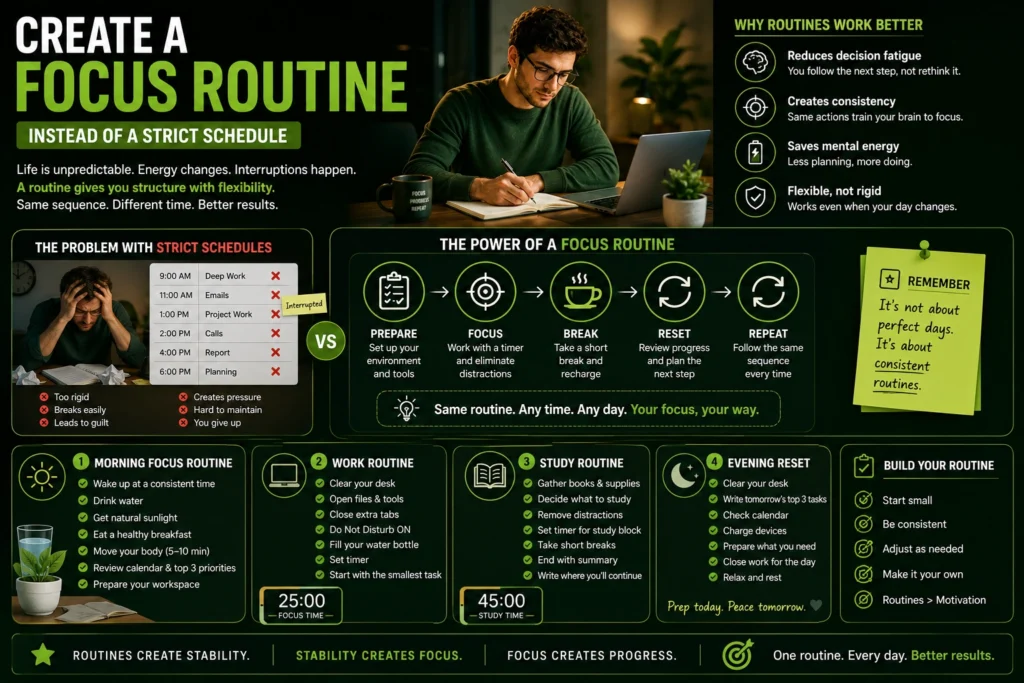
Many productivity systems are built around strict schedules—work from 9:00 AM to 11:00 AM, answer emails at exactly 2:00 PM, and complete every task according to a fixed timetable.
For people with ADHD, this approach often creates unnecessary pressure.
Life doesn’t always go according to plan. Some days you’ll have more energy than others. Unexpected interruptions happen, motivation changes, and your ability to concentrate can vary throughout the day. When a rigid schedule falls apart, it’s easy to feel like you’ve failed and give up on the rest of the day.
A focus routine works differently.
Instead of telling yourself exactly when everything must happen, it gives you a consistent sequence of actions to follow whenever you’re ready to work. The routine stays the same, even if the clock doesn’t.
This flexibility makes it easier to stay productive without feeling trapped by an unrealistic schedule.
Why Routines Work Better Than Strict Schedules
People with ADHD often struggle with task switching, decision fatigue, and getting started. Every time you ask yourself, “What should I do next?” your brain has to make another decision.
A routine removes that uncertainty.
When the same actions happen in the same order every day, they become automatic. Instead of spending mental energy deciding what comes next, you simply follow your routine.
Think of a routine as a checklist rather than a timetable. It creates structure while still allowing room for flexibility.
Morning Focus Routine
The way you begin your morning can influence your attention for the rest of the day. Instead of reaching for your phone immediately, create a simple routine that helps your brain wake up and prepare for focused work.
A healthy morning routine might include:
- Wake up at a consistent time whenever possible.
- Drink a glass of water.
- Open the curtains or spend a few minutes in natural sunlight.
- Eat a protein-rich breakfast if it fits your needs.
- Do five to ten minutes of light stretching or walking.
- Review your calendar and identify your top three priorities.
- Prepare your workspace before starting your first task.
The goal isn’t to have a perfect morning. It’s to reduce decision-making and create a calm transition into the day.
Work Routine
Starting work becomes much easier when you repeat the same preparation process every time.
Before each focus session, follow a simple routine like this:
- Clear your desk.
- Open the files and tools you’ll need.
- Close unnecessary tabs.
- Turn on Do Not Disturb mode.
- Fill your water bottle.
- Set a timer for your focus session.
- Start with the smallest task on your list.
Repeating these same steps every day trains your brain to associate this routine with focused work. Over time, you’ll spend less energy trying to get started and more energy actually making progress.
Study Routine
If you’re a student or learning a new skill, consistency matters more than studying for hours at a time.
Before you begin studying:
- Gather your books, notes, and supplies.
- Decide exactly what you’ll study during this session.
- Remove distractions from your desk.
- Set a timer for your study block.
- Take a short break after each session.
- End by writing down where you’ll continue next time.
Knowing exactly where to start during your next study session reduces procrastination and makes it easier to build momentum.
Evening Reset
A productive day often begins the night before.
Instead of ending your day without a plan, spend five to ten minutes preparing for tomorrow.
Your evening reset could include:
- Clear your desk.
- Put away unnecessary items.
- Write tomorrow’s three most important tasks.
- Check your calendar for upcoming appointments.
- Plug in your laptop and phone to charge.
- Lay out anything you’ll need in the morning.
- Close your work for the day and allow yourself to relax.
This simple habit reduces morning stress because you won’t have to figure out where to begin when you wake up.
Build a Routine You Can Actually Follow
The best routine isn’t the one that looks perfect online—it’s the one you’ll realistically stick with every day.
Start small. Choose a few habits that make it easier to begin your work, and repeat them consistently. As those habits become automatic, you can gradually add more structure.
For people with ADHD, routines create stability without the pressure of rigid schedules. They reduce decision fatigue, make task initiation easier, and help you focus on what matters most—making steady progress, one day at a time.
6. Try Body Doubling
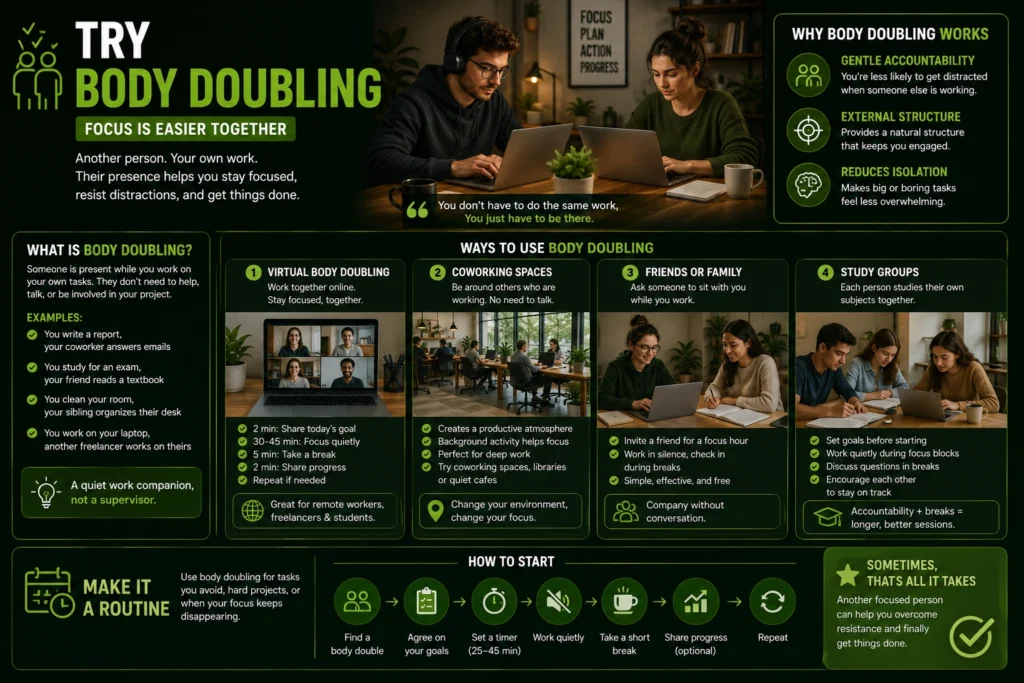
If you’ve ever noticed that it’s easier to focus when someone else is in the room—even if they’re quietly working on their own—you’ve already experienced one of the most effective ADHD productivity techniques: body doubling.
Body doubling is a simple strategy where another person is present while you work. They don’t need to help with your task, give advice, or even talk to you. Their presence alone can make it easier to stay focused, resist distractions, and complete what you’ve started.
Many adults with ADHD use body doubling for work, studying, household chores, and even routine tasks they’ve been putting off for weeks.
What Is Body Doubling?
A body double is someone who works alongside you while each of you focuses on your own responsibilities.
For example:
- You write a report while your coworker answers emails.
- You study for an exam while your friend reads a textbook.
- You clean your room while your sibling organizes their desk.
- You work on your laptop while another freelancer works on theirs.
The important part isn’t that you’re working on the same project—it’s that someone else is present, creating a sense of accountability and helping you stay engaged.
Think of body doubling as having a quiet work companion rather than a supervisor.
Why Body Doubling Works
People with ADHD often find it easier to stay focused when they’re not working completely alone.
Having another person nearby can help in several ways.
First, it creates gentle accountability. You’re naturally less likely to scroll through social media or leave your desk when someone else is also concentrating on their work.
Second, it provides external structure. Instead of relying entirely on self-motivation, the shared work environment encourages you to keep going, even during moments when your attention begins to drift.
Finally, body doubling reduces the feeling of isolation that many people experience during difficult or repetitive tasks. Simply knowing someone else is working alongside you can make large projects feel less overwhelming.
Many people are surprised by how much easier it becomes to start a task when they aren’t doing it alone.
Ways to Use Body Doubling
Body doubling doesn’t require special equipment or formal planning. The goal is simply to create an environment where focused work feels more natural.
Here are several ways to use it in everyday life.
Virtual Body Doubling
You don’t have to be in the same room for body doubling to work.
Many people use video calls while each person quietly works on their own tasks. After agreeing on what they’ll accomplish, everyone mutes their microphones and focuses until the timer ends.
A typical session might look like this:
- Spend two minutes sharing today’s goal.
- Work quietly for 30 to 45 minutes.
- Take a short break.
- Briefly discuss what you completed.
- Start another focus session if needed.
Virtual body doubling is especially helpful for remote workers, freelancers, and students who spend most of their day working alone.
Coworking Spaces
If working from home makes it difficult to stay focused, consider spending part of your day in a coworking space or a quiet public workspace.
Being surrounded by other people who are also working often creates a productive atmosphere without requiring direct interaction.
The background activity can provide just enough structure to help you remain focused while still allowing you to work independently.
If a coworking space isn’t available, a quiet library or local café may provide a similar environment.
Friends or Family Members
Body doubling can be as simple as asking someone you trust to sit with you while you work.
For example:
- Ask a friend to join you for an hour of focused work.
- Sit at the kitchen table while a family member pays bills or reads.
- Work together in silence, checking in only during scheduled breaks.
You don’t need constant conversation. In fact, the most effective body-doubling sessions are usually quiet and distraction-free.
Study Groups
Students with ADHD often find studying easier when they do it with others.
A productive study group doesn’t have to mean everyone is discussing the same material. Each person can work on different subjects while sharing the same study session.
To keep the session effective:
- Decide what you’ll accomplish before you begin.
- Work quietly during each focus block.
- Save questions and conversations for break times.
- Encourage one another to stay on task.
This structure combines accountability with regular breaks, making long study sessions feel much more manageable.
Make Body Doubling Part of Your Routine
You don’t have to rely on body doubling every day, but it can be incredibly useful for tasks you’ve been avoiding or projects that require sustained attention.
If you notice yourself procrastinating, struggling to get started, or repeatedly losing focus, try inviting someone to work alongside you—either in person or online.
For many people with ADHD, the difference is immediate. Sometimes the presence of another focused person is all it takes to overcome mental resistance, stay engaged, and finally finish the work you’ve been putting off.
7. Use Timers the Right Way
For many people with ADHD, getting distracted doesn’t happen because they don’t care about the task. It happens because the brain struggles to recognize the passage of time.
You may plan to work for 20 minutes, but suddenly realize an hour has passed without making progress. Other times, you might spend far longer on one task than intended and have no time left for everything else.
Timers solve this problem by making time visible.
Instead of guessing how long you’ve been working, a timer creates a clear beginning and end for every focus session. It reduces mental pressure, makes it easier to start difficult tasks, and reminds you to take breaks before your brain becomes exhausted.
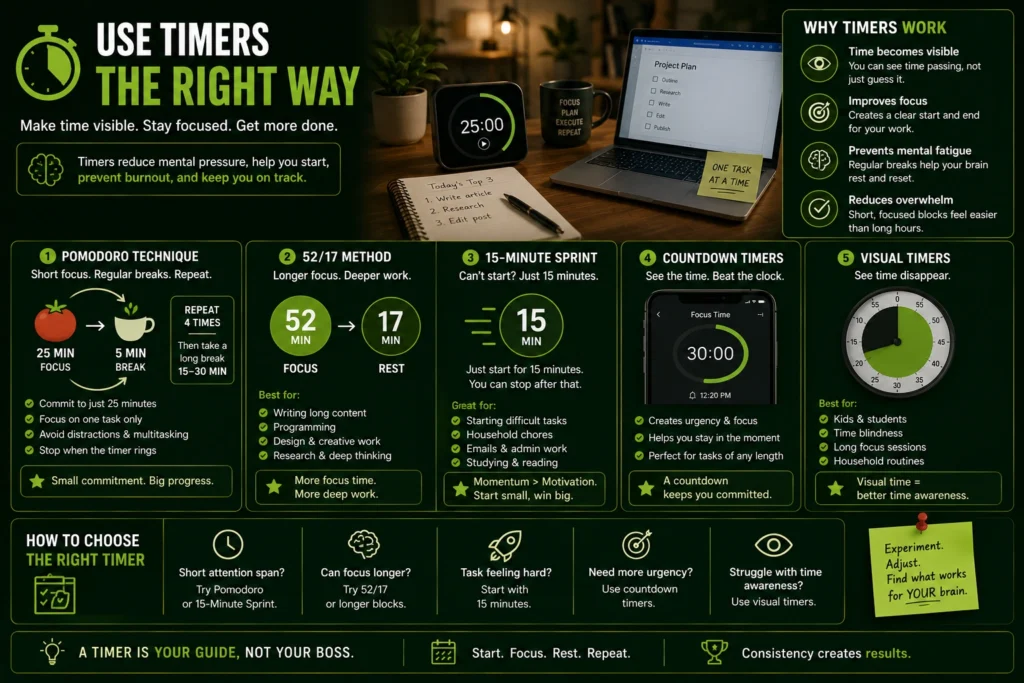
The key isn’t simply using a timer—it’s choosing a timing method that matches your attention span.
Pomodoro Technique
The Pomodoro Technique is one of the most popular productivity methods, and for good reason. It breaks work into short, focused sessions followed by regular breaks.
A typical Pomodoro cycle looks like this:
- Work for 25 minutes.
- Take a 5-minute break.
- Repeat four times.
- After four sessions, take a longer break of 15 to 30 minutes.
The biggest advantage is psychological. Committing to 25 minutes feels much less intimidating than telling yourself you’ll work for several hours.
During each work session:
- Focus on one task only.
- Ignore emails and notifications.
- Avoid switching between projects.
- Stop when the timer rings, even if you’re still motivated.
Those short breaks help prevent mental fatigue and allow you to return with renewed focus.
The 52/17 Method
Some people find that once they’re fully engaged, they can maintain concentration for longer than 25 minutes.
In that case, the 52/17 Method may be a better fit.
This approach involves:
- 52 minutes of focused work.
- 17 minutes of rest.
The longer work period allows for deeper concentration, while the extended break gives your brain enough time to recover before the next session.
This method works particularly well for:
- Writing long-form content.
- Programming.
- Graphic design.
- Research.
- Creative problem-solving.
If you notice that you’re just getting into a productive rhythm when a 25-minute timer ends, experimenting with longer sessions may help.
15-Minute Sprint
When you’re avoiding a task or can’t seem to get started, even 25 minutes may feel overwhelming.
That’s where the 15-Minute Sprint becomes useful.
Instead of thinking about the entire project, tell yourself:
“I’ll work on this for just 15 minutes.”
That’s it.
Knowing you’ll stop soon reduces mental resistance and makes it easier to begin.
More often than not, once those 15 minutes are over, you’ll already have enough momentum to continue.
This strategy works especially well for:
- Starting difficult projects.
- Household chores.
- Responding to emails.
- Studying.
- Administrative work.
- Any task you’ve been procrastinating on.
The goal isn’t to finish everything—it’s simply to get moving.
Use Countdown Timers
A countdown timer creates a sense of urgency that many people with ADHD find motivating.
Instead of watching time pass, you can clearly see how much time remains.
Whether you use your phone, smartwatch, kitchen timer, or computer, the countdown keeps your attention anchored to the current task.
For example:
- Set 20 minutes for writing.
- Set 30 minutes for studying.
- Set 10 minutes for cleaning.
- Set 45 minutes for project work.
Knowing the finish line is approaching often makes it easier to stay focused until the timer ends.
Try Visual Timers
Some people with ADHD respond even better to visual timers than traditional digital clocks.
Unlike a standard timer that simply displays numbers, a visual timer lets you see time disappearing as a colored section gradually shrinks.
This makes abstract time feel more concrete.
Visual timers are especially helpful for:
- Children with ADHD.
- Students.
- Adults who experience time blindness.
- Long focus sessions.
- Household routines.
Watching time decrease visually can improve time awareness and make transitions between activities feel more natural.
Find the Timing Method That Fits Your Brain
There’s no perfect timer for everyone.
Some people thrive with 25-minute Pomodoro sessions, while others do their best work during 45- or 60-minute focus blocks. On difficult days, even a 15-minute sprint can be enough to overcome procrastination and build momentum.
The important thing is to experiment until you discover what works for you.
A timer isn’t there to pressure you—it acts as a guide. It gives your work a clear beginning, a defined end, and regular opportunities to rest. For people with ADHD, that simple structure can make staying focused feel far more manageable than trying to rely on willpower alone.
8. Build Dopamine Bridges
One of the biggest challenges with ADHD isn’t knowing what to do—it’s getting your brain interested enough to start doing it.
Tasks like answering emails, studying for an exam, organizing files, or completing paperwork often don’t provide immediate satisfaction. As a result, your brain may keep searching for something more stimulating, like checking social media, watching videos, or switching to another activity.
This is where dopamine bridges can help.
A dopamine bridge is a simple strategy that pairs a less enjoyable task with something you genuinely enjoy. The goal isn’t to distract yourself from the work, but to make it more engaging so your brain is more willing to begin and stay with it.
Instead of waiting for motivation to appear, you create an environment that naturally makes working feel easier.
Pair Difficult Work With Enjoyable Activities
The secret to using dopamine bridges effectively is choosing rewards or enjoyable experiences that support your focus rather than compete with it.
For example, listening to loud music with lyrics while writing an important report may divide your attention. On the other hand, playing soft instrumental music or sipping your favorite coffee while working can make the task feel more pleasant without pulling your focus away.
Think of it as making work more inviting instead of more entertaining.
Small changes in your environment can reduce the mental resistance that often comes with starting difficult tasks.

Enjoy Your Favorite Coffee or Tea
For many people, a warm cup of coffee or tea becomes part of their focus ritual.
Preparing your favorite drink before sitting down to work creates a positive association with the task ahead. Over time, your brain begins linking that familiar routine with productivity.
If you enjoy caffeine, consume it in moderation and pay attention to how your body responds. Some people with ADHD find that a moderate amount improves alertness, while others may become more anxious or restless.
The goal is to create a comfortable work experience, not rely on caffeine as your only source of motivation.
Listen to Music That Supports Concentration
The right background music can make repetitive or mentally demanding work feel less draining.
Many people with ADHD find it easier to focus while listening to:
- Instrumental music.
- Lo-fi beats.
- Classical music.
- Brown noise.
- Rain sounds.
- Nature sounds.
- Ambient background music.
Avoid songs with lyrics if you notice they pull your attention away from reading, writing, or problem-solving.
Experiment with different types of audio until you find what helps you stay engaged without becoming another distraction.
Try a Standing Desk or Change Your Position
Sitting in the same position for long periods can make it harder to maintain attention.
Alternating between sitting and standing adds gentle movement throughout the day, helping some people feel more alert and engaged.
If you don’t have a standing desk, you can still change your environment by:
- Working at a kitchen counter for a while.
- Standing during phone calls.
- Taking short walking breaks between focus sessions.
- Stretching before starting your next task.
Sometimes a simple change in posture is enough to refresh your attention.
Create an Environment You Enjoy
Your surroundings have a bigger impact on focus than you might realize.
A workspace that feels comfortable, clean, and inviting can reduce mental resistance before you even begin working.
Consider adding small touches such as:
- Natural light whenever possible.
- A comfortable chair.
- A tidy desk.
- A small plant.
- Minimal clutter.
- A pleasant room temperature.
- Noise-canceling headphones if your environment is busy.
You don’t need a picture-perfect office. You simply need a space where your brain feels comfortable settling into work.
Reward Yourself After Finishing a Task
People with ADHD often benefit from immediate rewards because distant goals don’t always provide enough motivation.
Instead of waiting until the end of the week to celebrate your progress, give yourself small rewards after completing important tasks.
For example:
- Enjoy a favorite snack after finishing a work session.
- Watch one episode of a TV show after completing your priority task.
- Take a short walk outside.
- Spend ten minutes reading a book you enjoy.
- Play a game for a few minutes after reaching a milestone.
The reward doesn’t need to be expensive or time-consuming. It simply gives your brain something positive to look forward to after putting in focused effort.
Make Work Easier to Start
Many productivity tips focus on increasing discipline, but people with ADHD often benefit more from increasing engagement.
Dopamine bridges help by making difficult tasks feel less intimidating and more rewarding. Whether it’s enjoying your morning coffee, listening to calming music, working in a comfortable environment, or giving yourself a small reward afterward, these simple habits can lower the mental barrier to getting started.
The goal isn’t to trick your brain—it’s to create conditions where focusing feels more natural. When work becomes even slightly more enjoyable, showing up consistently becomes much easier, and those small improvements can lead to meaningful progress over time.
9. Reduce Digital Distractions
Smartphones, social media, and constant notifications make it difficult for anyone to stay focused. For people with ADHD, the challenge is often even greater because the brain is naturally drawn to anything that feels new, interesting, or rewarding.
You might open your laptop to finish an important project, only to check one notification. A few minutes later, you’re scrolling through social media, replying to messages, or watching videos, and the task you planned to complete has been forgotten.
The problem isn’t a lack of self-control. Modern apps are intentionally designed to capture and hold your attention.
Instead of relying on willpower alone, create an environment where distractions are less likely to interrupt your work.
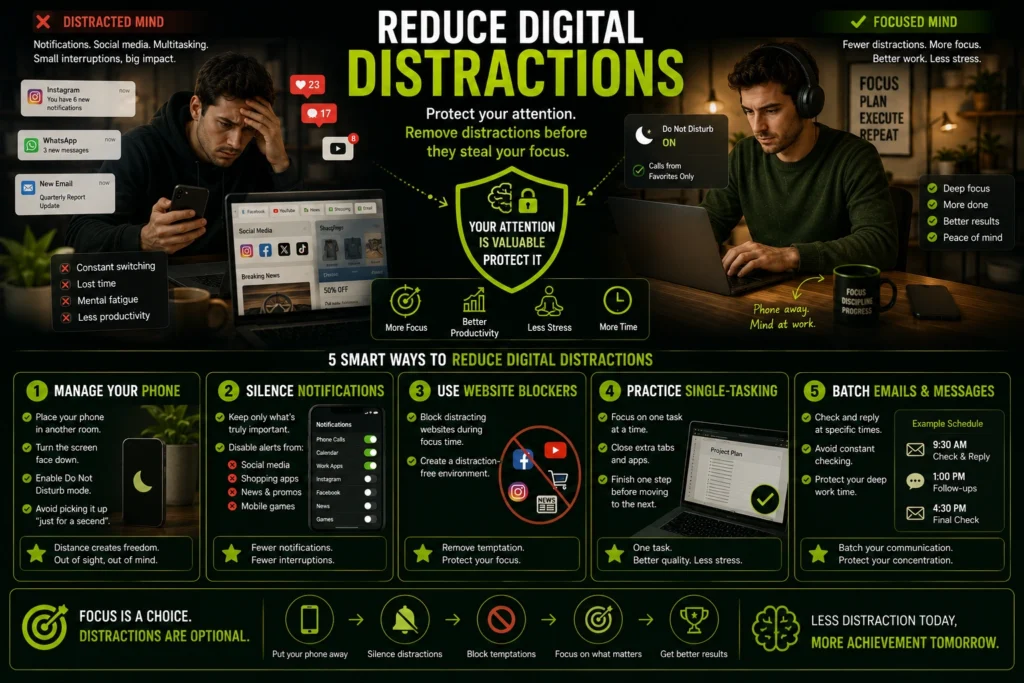
Manage Your Phone Intentionally
Your phone can be one of the biggest obstacles to maintaining focus. Even if you don’t pick it up, simply seeing it on your desk can tempt you to check messages or notifications.
Before starting a focus session:
- Place your phone in another room if possible.
- Turn the screen face down.
- Enable Do Not Disturb mode.
- Keep only emergency calls enabled if necessary.
- Avoid unlocking your phone “just for a second.”
If you genuinely need your phone for work, use only the apps required for the task and resist switching to social media or entertainment apps until your work session is complete.
Creating physical distance between yourself and your phone often makes it much easier to stay focused.
Customize Your Notification Settings
Every notification competes for your attention.
A single vibration or pop-up message may interrupt your concentration, and returning to the task can take much longer than expected.
Take a few minutes to review your notification settings and ask yourself:
- Do I really need instant alerts from this app?
- Can this notification wait until later?
- Does this help me or distract me?
Keep notifications enabled only for apps that are genuinely important, such as:
- Phone calls.
- Calendar reminders.
- Essential work communication.
- Security alerts.
Disable alerts for:
- Social media.
- Shopping apps.
- News notifications.
- Promotional emails.
- Mobile games.
Fewer notifications mean fewer interruptions and more uninterrupted time for meaningful work.
Use Website Blockers During Focus Sessions
Sometimes the hardest part of staying focused is resisting the habit of opening distracting websites.
Website blockers remove that temptation by temporarily restricting access to sites that often steal your attention.
You might choose to block:
- Social media platforms.
- Video streaming websites.
- News sites.
- Online shopping.
- Entertainment blogs.
Knowing these websites are unavailable makes it easier to stay committed to your current task instead of relying on self-control every few minutes.
Even blocking distractions for just 30 to 60 minutes can make a noticeable difference in productivity.
Practice Single-Tasking
Many people believe multitasking helps them get more done, but research consistently shows that switching between tasks reduces efficiency and increases mistakes.
For people with ADHD, constant task switching can make it even harder to regain focus.
Instead of trying to do several things at once:
- Work on one project.
- Keep only the necessary apps open.
- Finish one step before moving to the next.
- Avoid checking messages while writing or studying.
Ask yourself one simple question:
“What is the single most important thing I should be doing right now?”
Then give that task your full attention until your timer ends.
Single-tasking often leads to better quality work and less mental exhaustion than constantly dividing your attention.
Batch Your Email and Messages
Checking email every few minutes may feel productive, but it keeps your brain in a constant state of interruption.
Instead of reacting to every new message, choose specific times during the day to review and respond to email.
For example:
- 9:30 AM: Check and reply to urgent messages.
- 1:00 PM: Respond to follow-ups.
- 4:30 PM: Clear remaining emails before finishing work.
Outside these scheduled times, keep your inbox closed while working on important tasks.
The same approach works for messaging apps.
Rather than replying throughout the day, batch your responses into dedicated communication sessions. This allows you to protect your most productive hours for focused work instead of constantly switching between conversations and projects.
Protect Your Attention Like a Valuable Resource
Attention is one of your most valuable resources, especially if you have ADHD. Every notification, unnecessary browser tab, and social media scroll takes a small piece of that attention away.
You don’t need perfect discipline to stay focused. You need fewer opportunities to become distracted.
By managing your phone, limiting notifications, blocking distracting websites, focusing on one task at a time, and checking emails in batches instead of constantly, you’ll create an environment that supports concentration instead of working against it.
The less energy you spend fighting distractions, the more energy you’ll have for doing meaningful work.
10. Use Music, White Noise, or Brown Noise
The environment around you plays a bigger role in your ability to focus than you might realize. For many people with ADHD, complete silence isn’t always the best option. Small background noises—a conversation in another room, traffic outside, or a phone vibrating—can quickly pull attention away from the task at hand.
The right type of background sound can help reduce these distractions by giving your brain a consistent stream of low-level stimulation. Instead of constantly reacting to every new noise, your mind has something steady to settle into.
There’s no single sound that works for everyone. Some people concentrate best with soft music, while others prefer natural sounds or different types of noise. The key is to experiment and discover what helps you stay engaged without becoming another distraction.
What Sounds Work Best for ADHD?
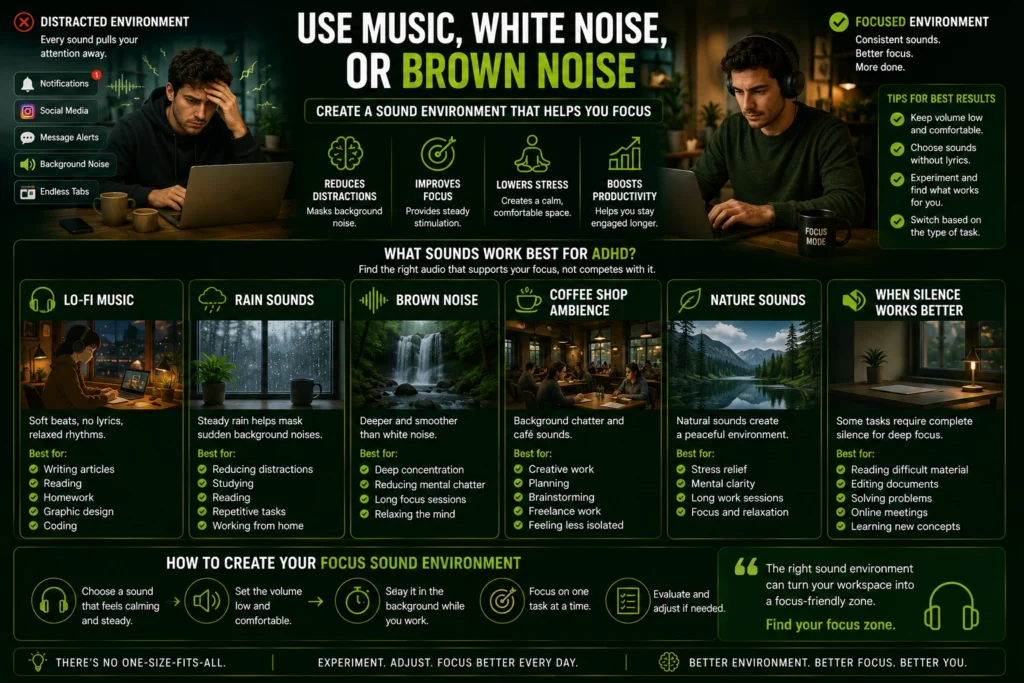
Background audio should support your focus, not compete with it.
A good choice is something predictable and calming that fades into the background after a few minutes. If you’re constantly paying attention to the music itself, it’s probably too stimulating for deep work.
Many people with ADHD find success with:
- Instrumental music
- Lo-fi beats
- White noise
- Brown noise
- Rain sounds
- Nature sounds
- Coffee shop ambience
The best option depends on the type of work you’re doing and your personal preferences.
Lo-Fi Music
Lo-fi (low-fidelity) music has become a favorite among students, writers, and remote workers because it’s designed to stay in the background.
Most lo-fi tracks feature:
- Soft instrumental melodies
- Relaxed rhythms
- Minimal changes in volume
- No distracting lyrics
Because there are no words to process, your brain can stay focused on reading, writing, or studying instead of following the song.
Lo-fi works particularly well for:
- Writing articles
- Reading
- Homework
- Graphic design
- Coding
- Administrative work
If you find complete silence uncomfortable, lo-fi can create a calm and productive atmosphere.
Rain Sounds
The steady sound of rainfall creates a consistent background that can help mask sudden noises from your surroundings.
Many people use rain sounds because they:
- Reduce awareness of conversations nearby.
- Cover traffic or household noise.
- Create a calming work environment.
- Help maintain attention during repetitive tasks.
Rain sounds are especially useful if you work from home or in a noisy office where unexpected sounds frequently interrupt your concentration.
Brown Noise
Although white noise is well known, many adults with ADHD say they prefer brown noise.
Brown noise has a deeper, softer sound with more low-frequency tones, making it feel less harsh than white noise.
People often describe it as similar to:
- A distant waterfall
- Heavy rainfall
- Low ocean waves
- A gentle rumble
Some individuals find brown noise particularly helpful for reducing mental distractions and creating a stable background for focused work.
While experiences vary from person to person, it’s worth trying if other background sounds haven’t worked well for you.
Coffee Shop Ambience
Have you ever noticed that it’s sometimes easier to work in a café than at home?
The gentle mix of quiet conversations, cups clinking, espresso machines, and background movement provides a level of stimulation that many people with ADHD find motivating.
If you enjoy that atmosphere but prefer working from home, you can recreate it with coffee shop ambience recordings.
These recordings work well for:
- Creative writing
- Reading
- Freelance work
- Planning sessions
- Brainstorming ideas
The background activity can make working alone feel less isolating while still allowing you to concentrate.
Nature Sounds
Natural environments have long been associated with relaxation and mental clarity.
Listening to sounds such as:
- Ocean waves
- Flowing rivers
- Forest birds
- Gentle wind
- Waterfalls
can help create a peaceful workspace and reduce stress during long work sessions.
Nature sounds are particularly useful when you’re feeling mentally overwhelmed or need a calmer environment to regain focus.
When Silence Works Better
Although background audio helps many people with ADHD, it isn’t always the best choice.
Some tasks require intense concentration and language processing. During these activities, even instrumental music can become distracting.
You may find silence more effective when:
- Reading complex material.
- Editing important documents.
- Solving mathematical problems.
- Learning unfamiliar concepts.
- Having online meetings or interviews.
Pay attention to how your brain responds. If you notice yourself listening to the music instead of focusing on your work, switch it off and try working in silence for a while.
Experiment Until You Find Your Focus Zone
There isn’t a universal “best” sound for ADHD. What helps one person concentrate may distract someone else.
Try different options for a few days each and notice how they affect your attention, energy, and productivity. You might discover that lo-fi works best for writing, rain sounds help during administrative tasks, and complete silence is ideal for reading or problem-solving.
The goal isn’t to create the perfect playlist—it’s to build an environment where staying focused feels easier. Small adjustments to your workspace, including the sounds around you, can make a meaningful difference in how well you concentrate throughout the day.
Final Thoughts
Learning how to focus with ADHD without medication isn’t about finding one perfect technique that suddenly makes every day easy. It’s about understanding how your brain works and building habits that make focusing feel more natural over time.
Some strategies will work well for you, while others may not fit your lifestyle or personality—and that’s completely normal. ADHD affects everyone differently, so the goal isn’t to copy someone else’s routine. It’s to discover the tools and systems that help you stay focused, organized, and productive.
The good news is that you don’t have to transform your life overnight. Even small improvements can lead to meaningful progress when you apply them consistently.
Progress Over Perfection
One of the biggest obstacles for people with ADHD is believing that every day has to be perfectly productive.
In reality, there will be days when you lose focus, miss a routine, or struggle to complete your to-do list. That doesn’t mean you’ve failed.
Instead of aiming for perfection, focus on making steady progress.
If you planned to work for an hour but managed 20 focused minutes, that’s still progress. If you completed one important task instead of five, you’ve moved forward.
Success comes from showing up consistently—not from having perfect days.
Experiment With Different Strategies
There isn’t a universal productivity system that works for everyone with ADHD.
Some people thrive using the Pomodoro Technique, while others prefer longer focus sessions. One person may concentrate best with brown noise, while another needs complete silence. Some benefit from body doubling, while others do their best work alone.
Give each strategy enough time to evaluate it before deciding whether it works for you.
Ask yourself questions like:
- Did I stay focused longer today?
- Was it easier to start my work?
- Did I feel less overwhelmed?
- Which habits gave me the most energy?
Treat your productivity like an experiment. Keep what helps and let go of what doesn’t.
Build Systems Instead of Relying on Motivation
Motivation comes and goes.
Some mornings you’ll feel energized and ready to work. Other days, even simple tasks may seem impossible to begin.
That’s why successful ADHD management depends more on systems than on motivation.
Simple systems like:
- A consistent morning routine.
- Calendar reminders.
- Focus timers.
- Checklists.
- Prepared workspaces.
- Weekly planning sessions.
continue working even when motivation is low.
The easier your environment makes it to start, the less you’ll need to depend on willpower.
Consistency Beats Intensity
Many people try to make huge changes all at once.
They create strict schedules, long to-do lists, and ambitious goals—only to feel exhausted a few days later.
A better approach is to make small improvements you can realistically maintain.
Working for 25 focused minutes every day is often more effective than forcing yourself through one exhausting eight-hour session once a week.
Small daily habits create routines, and routines create long-term results.
Small Changes Compound Over Time
Improving focus rarely happens because of one dramatic breakthrough.
It happens because of dozens of small choices repeated over weeks and months.
Every time you:
- Break a task into smaller steps.
- Put your phone away before working.
- Use a timer.
- Follow your focus routine.
- Get enough sleep.
- Take a short movement break.
- Write tomorrow’s priorities the night before.
you’re strengthening habits that make focusing a little easier.
On their own, these actions may seem insignificant. Together, they create a work environment that supports your brain instead of constantly fighting against it.
Remember This
Living with ADHD doesn’t mean you’re incapable of focusing—it means your brain responds differently to attention, motivation, and structure.
Once you stop trying to force yourself into productivity systems that weren’t designed for the way your brain works, you’ll begin to discover strategies that feel more natural and sustainable.
Start with one or two techniques from this guide, practice them consistently, and adjust as you learn what works best for you. Over time, those small improvements can lead to better focus, less frustration, and greater confidence in your ability to manage daily life—whether you use medication or not.